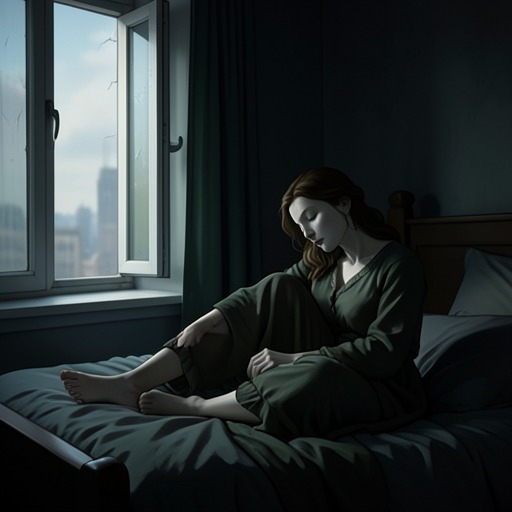
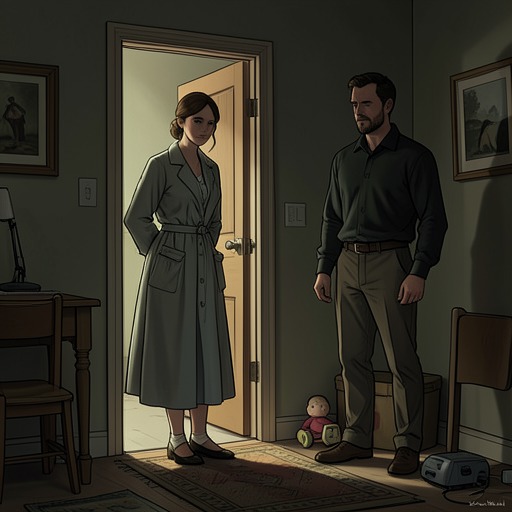
Anna is frightened by children throwing eggs on Halloween
The Woman in the WindowAnna is frightened by children throwing eggs on Halloween, an episode in which a small act of vandalism breaches the safety of her home and leaves her unable to face the street alone. When she finally opens the door, the outside world overwhelms her; Jane Russell intervenes, brings her inside, and becomes the first neighbor Anna meets in person.
The disturbance at the door
The episode begins with Anna Fox on the sofa, watching the extended heist sequence in Rififi. Its half-hour without dialogue or music leaves only the sounds within the film and, as Anna puts it, the hum of blood in the ears. The contrast is immediate: the quiet of the movie is interrupted by a dull knock at the front door, followed by another.
Anna approaches the door through the hall, a dim, cool passage she distrusts as the boundary between her private world and the outside. Looking through the leaded glass, she sees an egg strike the window and spread across it. Three children are in the street; one still holds an egg. The attack is minor in scale but intimate in effect: the glass belongs to the entrance of Anna’s home, and the yolk marks the point where the children’s mischief reaches her refuge.
Fear turns to confrontation
Anna cannot fling the door open to drive the children away or go outside to confront them. Instead, she knocks sharply on the window and slaps the door with the heel of her hand. The repeated impact echoes the egg’s blunt thud: the children’s action has made the entrance a contested threshold, while Anna’s attempts to answer them remain safely on its inner side.
She tries to summon resolve by recalling her years of graduate study, training in inner-city schools, and seven years of practice. She has promised herself that she is tough, but the reassurance does not end the crisis. Scraping her hair back, she retreats to the living room, pulls in a breath, and presses the intercom. Her message, “Get away from my house,” is an attempt to assert authority without stepping into the street. Another egg strikes the door.
The pressure builds into a sudden reversal. Anna rushes downstairs and returns to the hall, angry and struggling to see clearly. She takes two breaths, counts, and jolts the door open. For an instant she registers the houses opposite, the children between them, and the street held in stillness. Then the moment of apparent control gives way: the world seems to swell toward her, and she folds under the force of her panic. Her vision blurs through red, darkness, and white; she tastes grit and blood and feels herself fall against the ground. The narration recalls that she has fallen on these same steps before, but this time there are no voices around her.
Jane Russell steps in
Anna comes back to herself being supported by someone with an arm around her neck. Coarser hair brushes her face, and the person helps her from the hall into the living room. The rescuer is Jane Russell, the neighbor from across the park. Jane explains that she was heading next door when she saw the children throwing eggs; she challenged them, then saw Anna lurch through the open door and collapse. The account establishes that Jane did not witness an assault by another adult: she saw the egging and Anna’s fall, and responded by helping her.
At the kitchen sink, Anna cups her hands over her nose and mouth and tries to calm her breathing. Jane brings her two glasses, one of water and one containing a thick golden drink. She hopes it is brandy, but Jane admits she does not know whether brandy helps. Her joking comparison of herself to Florence Nightingale gives the scene a lighter note without obscuring Anna’s pain: her lip aches, and her speech feels unsteady.
Anna recognizes the woman as Jane Russell. Jane pauses in surprise and asks how Anna knows her name. Anna explains that Jane’s son came by. The exchange links the rescue to an earlier contact between the households, while marking this as Anna’s first direct encounter with Jane. What begins with a stranger’s intervention ends with recognition and conversation inside Anna’s home.
The threshold as a turning point
The scene’s decisive movement is not that Anna masters her fear: she opens the door, but collapses almost at once. Instead, the opening creates the conditions for another person to reach her. The front door is at once the point of vulnerability, the line Anna cannot cross without distress, and the entrance through which Jane brings assistance. The children’s eggs make the boundary visible on the glass; Anna’s fall makes its psychological weight bodily.
The episode also shifts the meaning of the disturbance. Before Jane appears, the knocks and impacts isolate Anna with a threat she cannot answer directly. Jane’s account supplies an outside perspective on what happened, and her practical care brings the street into Anna’s living room in the form of a neighbor rather than a danger. The rescue does not erase Anna’s panic, but it changes the consequence of opening the door: the encounter establishes a human connection where the children’s intrusion had seemed to leave only fear.